

Showing posts with label review. Show all posts
Showing posts with label review. Show all posts
Thursday, May 10, 2012
Uncharted 3

Monday, April 23, 2012
Psychonauts
It's easy to forget that gaming has a vast library. It's a hit-driven industry, and gamers have short-term memory. Once we finish the latest and greatest, we look forward to the next big thing. When you live from release to release like that, it's easy to criticize the industry for being too uniform, too safe, and too conservative. Genres have condensed, others have evaporated, and it just feels like we're playing the same damn thing over and over. But when you dig into gaming's enormous library, you can dig up an absolute gem that feels fresher and more innovative than any game that's come out in years.
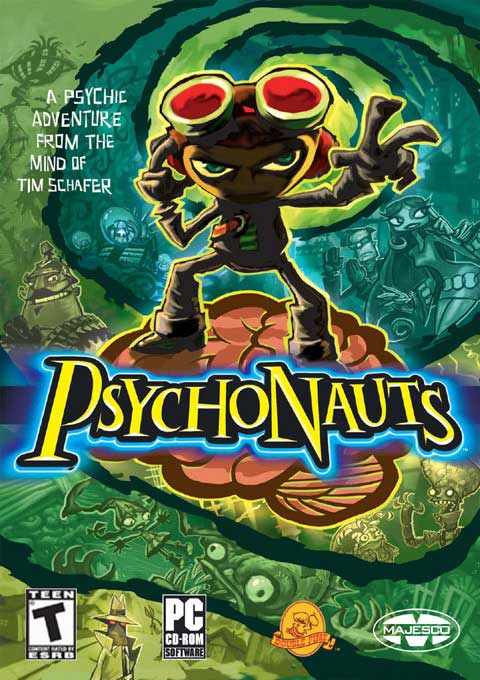
From the excellent minds at Double Fine, Psychonauts is a platforming adventure for the PS2, Xbox, and PC. You play as Raz, a boy who goes to psychic summer camp in order to become a Psychonaut—a kind of psychic secret agent.
I confess, the art style turned me off at first, but it definitely grew on me. Perhaps being inundated by bald space marines, colorless military grunts, and Japanesy anime characters has left me more receptive to anything that doesn't resemble the aforementioned styles. The art is charming, unique, and completely appropriate.
Psychonauts successfully merges the gameplay with narrative. The level design is artistically and mechanically demented. Rooms turn topsy-turvy, disorienting your perspective, and provides unique navigational challenges. New abilities are gained under the guise of "Merit Badges," tying into the game's setting of summer camp. Each stage is trip through a different character's mind, and gives the designers an excuse to throw you through a variety of gameplay types, from light puzzle solving to straight-up combat. Rest assured, all your psychic powers will come handy at some point, whether to solve a puzzle or defeat a boss, the game doesn't leave any power unused.
Platformers are fundamentally about collecting stuff, and Psychonauts doesn't lack in that department. Each stage is filled with collectibles that help raise your rank (the max rank is 100). Advancing in rank grants new abilities and upgrades existing powers. Trying to nab every last figment will test your ingenuity and willingness to explore the levels.
The game is rife with unusual characters, accented voices, and clever lines. The story's an enjoyable romp that feels like an animated movie or Saturday morning cartoon, but it’s punchy and clever. The main adventure lasts about ten hours, but you can tack on a few more extra if you're a completionist.
If you’re a fan of fun, clever, and devilish platformers, you owe it to yourself to play Psychonauts. You won't be disappointed.
Monday, April 16, 2012
Deus Ex: Human Revolution
Deus Ex is amazing.
The core gameplay allows for multiple approaches to a situation. It's possible to go through the entire game without killing a single person (bosses aside). In some ways, it’s my dream game. It’s a perfect blend of free exploration a la Skyrim, the cover-based stealth mechanics of Splinter Cell, and the branching narrative of Mass Effect. It's like somebody took all the best ideas of Western game design and distilled it into one game.

A large part of this has to do with the impeccable map design. The levels are made with pockets of sneaking space, ventilation shafts, flowing cover, and different elevations to take advantage of Adam Jensen's unique traversal abilities. He can super jump, fall from great heights, punch through walls, and see through them. By that same token, locked doors can be blown up, hacked, or bypassed with codes lifted from Pocket Secretaries.
The game is all about stealth and punishes you appropriately for not moving around with finesse. Getting caught isn’t a death sentence, but unless you’re properly equipped, it might as well be. Even if you elect to go Rambo with your arsenal, you’ll still be utilizing cover a lot.
Whether it’s eliminating enemies with takedowns and headshots or bypassing security systems with vent-crawling and hacking, you are rewarded with XP. After gaining enough XP, you level up, granting “Praxis” points, the games upgrade currency. You use these points to upgrade augmentations that allow Jenson to move more effectively, hack more effectively, and kill more effectively. They’re a limited resource and force players into distinct play styles based on what kind of upgrades they acquire.
Now this could’ve been the greatest game of all time if it wasn’t for one little thing: the boss fights. The boss fights force an awkward style of gameplay incongruent with rest of the game’s design. If you’re going for a stealth-only run, encountering a boss fight is the moment you are screwed. They become frustrating roadblocks in an otherwise stellar experience.
Deus Ex fills out the definition of “cyberpunk” nicely, checking off the box for “hackers,” “corporations,” and “civil unrest” over the issue of human augmentation. The plot takes a backseat to the setting. Neo-Detroit and the fictional Chinese city of Hengsha are appropriately dark, seedy, and technologically-infused in its realization. Hacking computers to read emails and picking up ebooks flesh out more of the world’s backstory.
The game does suffer from drawbacks. Certain augments are completely useless and the hacking minigame gets tiresome quickly. Just like in Mass Effect and Bioshock, an interesting time diversion increasingly becomes a distraction to the core gameplay. Developers should realize that at the highest levels of hacking, the final upgrade should simply automate the process. I would certainly max out my hacking skills just to skip the minigame.
Unfortunately, the game ends with a bitter taste. The conclusion pays no heed to your choices throughout and essentially gives you an opportunity to view four slightly different cutscenes.
Deus Ex: Human Revolution is a fantastic experience marred by a couple boneheaded design decisions. If it weren’t for those missteps, I would have no trouble calling Deus Ex: Human Revolution a true masterpiece. As it is, it’s a pretty damn good game and among the best for 2011.
Saturday, April 14, 2012
Mass Effect 3
Mass Effect 3 is the final installment of Bioware's epic space opera trilogy.
As you've no doubt heard by now, the ending wasn't quite what most people were expecting. Sloppy finishes aside, does Mass Effect 3 live up to its storied name?


It's interesting to chart the series evolution (or devolution, some would argue) from start to finish. While the games maintain a similar core throughout, each installment contains radical differences. It's clear that with each game, the designers followed a new philosophy to—dare I say it—"dumb" it down for the masses. This jump is obvious between ME1 and ME2 with the omission of Mako side missions entirely. Rather then try to fix it; they simply eradicated it from existence.
While linear game design isn't always bad, for a series known for branching paths, the straightforwardness of ME3 is rather jarring. The difference in the amount of freedom between ME1 and ME3 is staggering. RPG enthusiasts may lament this more streamlined approach, but it isn't without merit. It guarantees a steady pace for the story and allows players to get down to business quickly.
There's really no excuse for getting rid of exploration entirely though. The Citadel remains the only hub world in the entire game, and every other location you visit you only visit once. That sense of world and environment has been replaced with "urgency" and set-pieces that funnel you through action-packed events. It's a style that works for Modern Warfare, but it's slightly out of place in ME3. At least it makes for some memorable moments. The adventures on various homeworlds, including the Krogan home planet of Tuchanka, will stick with you for a long time. Overlapped with these sequences are payoffs from decisions you've made years ago in the previous games, putting closure to dangling plot threads.
Although the RPG elements suffered, the core combat has improved by leaps and bounds. The introduction of roll dodges makes me wonder how we ever got along without it. Movement, aiming, and shooting are tighter, and the biotic powers spice up combat encounters quite nicely.
Character upgrades have essentially boiled down to combat abilities, which offer your usual assortment of buffs and debuffs, and a couple unique physics-driven showcases thrown in for good measure. The weapon upgrade system has been extremely simplified, reduced to merely buying upgrades for entire weapon classes and inserting mods. The options aren't as numerous as before.
Upon reflection, I realize that Bioware "cheats" with the narrative. The first game thrilled us with its fully realized universe, replete with detailed environments to explore and deep customization options. Our freedom has decreased steadily over the course of our journey, but in its place, we've shared experiences with our crew. As Commander Shepard, we’ve cultivated relationships with our shipmates, romanced some of them even, and let others die. Perhaps we were blinded by our devotion to these characters, for they kept us from seeing ME3's squandered potential.
ME3 abandons its RPG roots and aspires to be a shooter. Fortunately, ME3 is a more than competent at the task, and the use of biotic powers is unique enough to shield it from criticisms of imitating more accomplished genre franchises such as Gears of War or Uncharted.
Even though the story makes the game palatable, the ending ruins everything by invalidating all of the choices you've made in the previous 3 games. Whether you played as Renegade or Paragon has no bearing in the end, and it's completely antithetical to the game's philosophy. It introduces three arbitrary, binary, and bizarre choices with a poorly thought-out explanation for the Reaper invasion. When an ending proves so controversial that it forces Bioware to redo it (although they promise it will maintain their "artistic integrity"), that's when you know that that they've screwed up big time.
Mass Effect 3 is a great game, one of the best for this year possibly, but only for your virgin playthrough. Mass Effect has always encouraged replays with different styles, but when faced with such a disappointing end, the motivation to start up a new game is completely gone.
It's an adventure that no Mass Effect fan should miss out on; just make sure you turn the game off before going up the magic space elevator. Trust me, its better that way.
Thursday, April 12, 2012
One-Paragraph Reviews
I told myself that I would review every game I beat.
Too bad that never panned out.
I have a list of games that I've beaten and they demand to be reviewed, but I really don't have the time. So rather than write out multi-page critiques, I'm just going to go with my one-paragraph reviews.
Killzone 3: The visuals are amazing but the gameplay is middling. Aside from a few cool set pieces, it's superficially exciting and fundamentally dull.
Dead Space 2: What made the first game great was the pacing. There were moments of calm and moments of intensity. It was finely tuned to give players necessary breaks between enemy confrontations. The sequel throws this methodical approach out the window and presses its foot on the gas pedal full throttle. The adventure is frenetic, claustrophobic, and never gives you room to breathe, which is Dead Space 2's ultimate failing. Too much action and not enough calm.
Vanquish: A mash between combo-based action gaming and cover-based third-person shooting. A truly unique bullet ballet of explosions, slo-mo, and rocket sliding.
Ratchet and Clank: A Crack in Time: An incredible adventure with clever puzzles, enjoyable platforming, and solid action.
LA Noire: An interesting piece of narrative that really puts you in the shoes of a detective. Major flaws hold the game back from being great .
Resistance 3: With a varied arsenal of weapons and impeccable enemy encounter design, this is the best in the trilogy.
Shadows of the Damned: A well-crafted and unexpectedly funny journey through the depths of hell. Shades of RE4 and Suda's madness warrant a look from any gamer with a taste for the odd.
Battlefield 3: An average campaign with too many rails, but them graphics! Besides, the only reason you're playing this is for the multiplayer.
Modern Warfare 3: It's an exciting, action-packed, and nonsensical roller coaster ride from start to finish.
Bulletstorm: The most underrated game of the year. A unique blend of combo-based action gaming with first-person shooting (where have I heard this before?).
Gears of War 3: It has everything it needs except for a soul. A solid romp but nothing else, unless you're in it for the multiplayer.
Halo Anniversary: A remake of the best Halo game? Yes, please. The same fantastic core is intact, and with the new graphics, it makes this the best Halo game yet.
Too bad that never panned out.
I have a list of games that I've beaten and they demand to be reviewed, but I really don't have the time. So rather than write out multi-page critiques, I'm just going to go with my one-paragraph reviews.
Killzone 3: The visuals are amazing but the gameplay is middling. Aside from a few cool set pieces, it's superficially exciting and fundamentally dull.
Dead Space 2: What made the first game great was the pacing. There were moments of calm and moments of intensity. It was finely tuned to give players necessary breaks between enemy confrontations. The sequel throws this methodical approach out the window and presses its foot on the gas pedal full throttle. The adventure is frenetic, claustrophobic, and never gives you room to breathe, which is Dead Space 2's ultimate failing. Too much action and not enough calm.
Vanquish: A mash between combo-based action gaming and cover-based third-person shooting. A truly unique bullet ballet of explosions, slo-mo, and rocket sliding.
Ratchet and Clank: A Crack in Time: An incredible adventure with clever puzzles, enjoyable platforming, and solid action.
LA Noire: An interesting piece of narrative that really puts you in the shoes of a detective. Major flaws hold the game back from being great .
Resistance 3: With a varied arsenal of weapons and impeccable enemy encounter design, this is the best in the trilogy.
Shadows of the Damned: A well-crafted and unexpectedly funny journey through the depths of hell. Shades of RE4 and Suda's madness warrant a look from any gamer with a taste for the odd.
Battlefield 3: An average campaign with too many rails, but them graphics! Besides, the only reason you're playing this is for the multiplayer.
Modern Warfare 3: It's an exciting, action-packed, and nonsensical roller coaster ride from start to finish.
Bulletstorm: The most underrated game of the year. A unique blend of combo-based action gaming with first-person shooting (where have I heard this before?).
Gears of War 3: It has everything it needs except for a soul. A solid romp but nothing else, unless you're in it for the multiplayer.
Halo Anniversary: A remake of the best Halo game? Yes, please. The same fantastic core is intact, and with the new graphics, it makes this the best Halo game yet.
Saturday, November 19, 2011
Prey
 The announcement of Prey 2 spurred me on to beat the original, an intriguing sci-fi shooter with portals before Portal made portals cool.
 You play as Tommy, a Native-American who gets sucked up in a giant spaceship called the Sphere. The entire adventure revolves around his quest to save his girlfriend while navigating the Sphere's treacherous interior, filled with portals and gravity-defying catwalks. In the process, Tommy unlocks his heritage and gains access to his spirit form, which is necessary to solve basic navigation puzzles.
The game looks great with a dark, twisted, and fleshy interior. The lighting is moody and the monster design nightmarish. Unfortunately, the game ascribes to the template of corridor shooter, where the best tactic is classical strafe and fire. Enemy AI and level design aren't sophisticated enough to support the flanking style of gameplay Halo is known for. It boils down to point and shoot.
On the bright side, the game's armory is unique enough to make the task of shooting aliens fun. Pistols with secondary sniper function, bug bombs, and leech blasters are just some of the fantastic alien weaponry you'll get to wield.
The real star of Prey is the level design. The use of portals, perspective shifts, and reverse gravity makes the game unpredictable. Combined with the spirit form gameplay, simply walking through the ship is like solving one giant puzzle.
Prey's journey is fairly lengthy, easily running over ten hours, but the narrative is gripping enough to urge you on when times are tough. The game is a throwback to classic fps with a modern twist; a true bridge between old and new school.
Sunday, November 13, 2011
Battlefield Bad Company 2: Vietnam
 Considering my heritage, I could've welcomed this addition to Bad Company 2, but I've held out on getting it for the longest time. Now that I've played it, my decision was justified.
It's not that Vietnam is particularly bad, it's just awkwardly skewed in a few different places. The maps are suspiciously flat, which reduces the role of Recons a great deal (my de facto class). Certain maps seem to favor one team over the other, leading to an imbalanced game. The terrain just isn't very interesting to navigate and there aren't enough guns. The limited weapon selection reduces encounter variety and makes everything repetitious.
Pass over this expansion, it's not worth it.
Thursday, November 3, 2011
Fast Five
 Simplicity is underrated.
When things are simple, it's hard to screw up. This is the principle behind Fast Five.
It's not a terribly complex story, but it works in the movie's favor. It's about fast cars and explosions, character depth is unnecessary by design, so try to ignore the forced relationships, shallow characterization, and empty dialogue. You'll enjoy the movie a lot more that way.
I enjoyed the movie, even though it still suffers from frenetic Hollywood shaky cam syndrome. If it weren't for the nonsensical "gritty" screen shaking, one could actually appreciate the complexity and composition of the stunts. Alas, the world of action movies is forever tainted by the Bourne Supremacy.
Curse you Paul Greengrass.
Tuesday, August 30, 2011
Peace Walker

Peace Walker is one of the greatest PSP games I have ever played. Its fun, endlessly entertaining, and relentless addicting. It somehow merges the “gotta catch ‘em all” mentality of Pokémon with the trademark tactical espionage action that Metal Gear Solid is renowned for. Kojima Productions tailored the series’ gameplay for portable play, with great results.
The game follows the story of Big Boss and takes place after the events of Metal Gear Solid 3. Big Boss and a cohort, Kazuhira Miller, are in charge of the Militaires Sans Frontières (MSF), an independent army. What follows afterward is an adventure into the jungles of Costa Rica to fight against invading forces that seem to be lead by the CIA. I won’t spoil the story since a large part of the MGS experience is watching the plot unfold through the comic-animated cutscenes. Although the cinematics are no longer in real-time, each character is still fully fleshed out with hours and hours of voice-acting. There are some real gems in the game from audio tapes to hilarious codec conversations, so there isn’t anything lacking from the production values front.
The gameplay is an amalgamation of past Metal Gear games. It incorporates the soldier recruitment mechanic from Portable Ops, a stripped down version of MGS3’s camo system, and the user-friendly controls of MGS4. The level design and enemy AI is modified to suit the mission-based, modular, and compact game design. This is further emphasized with the structure, by breaking the core game modes into Main Ops and Extra Ops. This allows the developers to integrate multiplayer (both competitive and coop) into the main game’s framework. By making the entire game mission-based, it encourages bursts of play and to get the best ranking for each mission (S-rankings as per Japanese custom).
Whereas past Metal Gear games stacked innovation on top of the core mechanics (such as first-person shooting, camo systems, etc), Peace Walker decides to go sideways. The innovation isn’t in the gameplay, which is decidedly simplified compared to its console brethren, but in the packaging of the gameplay. Kojima Productions has created a network of subsystems that work together to create an ecosystem of causes and effects.
Each soldier you recruit has ratings, and you can assign soldiers to different units from combat, R&D, and Medical based on these ratings. By placing soldiers with high ratings in their respective categories in the right departments, you can unlock new weapons and gadgets. In order to unlock the best gadgets, you have to recruit the best soldiers, which are in the hardest missions, which can only be done with the best equipment. Everything goes in a beautiful circle that encourages you to collect the best of the best in everything.
With Peace Walker bundled as part of the upcoming Metal Gear Solid HD collection, there is reason for you not to experience such an excellent entry in the Metal Gear Solid series.
Peace Walker is amazing.
Play it.
Tuesday, July 26, 2011
Captain America: The First Avenger

Captain America is a decent movie.
That's my one-sentence review. Sure I can elucidate as to why its decent, but most people just want a recommendation of "see" or "not see." My recommendation is "sorta see."
The movie is character driven, and we see how the weak Steve Rogers becomes the awesome Captain America. Most of the actors do their job appropriately. Chris Evans sells his character, awkward around women, but awesome around Nazis (by virtue of punching them in the face). Hayley Atwell is surprisingly competent as Peggy Carter and Tommy Lee Jones does a solid job. My only complaint is Hugo Weaving's unsteady German accent as the Red Skull.
As far as superhero movies go, Captain America errs on the side of grounded. Despite being a supersoldier, Captain America doesn't engage in the special-effects laden hijinks of his modern buddies such as Thor or Ironman. The movie does have an old-school feel where punches are more effective than laser beams (though there's no shortage of that either).
A mix of old school, high tech, and heart, Captain America is a send up of superheroes from the golden age. If you're a fan of superheroes in general, watch it.
Tuesday, July 19, 2011
Buried
 Buried comes with a novel concept: have an entire movie take place inside a coffin. When I say the entire movie, I really do mean the entire movie. No flashbacks or nothing, just the coffin, the whole time. That doesn't mean our protagonist spends 90 minutes talking to himself in a wooden box. Fortunately, he was buried with a cell phone, and we get to watch him try to call for help (and hitting various dead-ends along the way).
Part of the fun of watching the movie is finding out exactly who this guy is and how he even got there. I won't spoil it since its part of the experience. The movie is effective, and if you have the slightest bit of claustrophobia, this movie might stretch your tolerance to the limit.
The movie is worth a watch, but you might end up with a hollow feeling by the movie's end--a feeling of pointlessness. As most movies go, it's all about the journey, not the end.
Saturday, July 16, 2011
The Bird People in China

In my quest to find more films by Japanese filmmaker Takashi Miike, I stumbled upon a messageboard talking about each user's favorite Miike movie. An oft echoed answer was The Bird People in China. Quite an odd title, considering Miike's filmography. It was a bitch trying to find a copy but when I finally did, I left it to simmer on my hard drive for well over 4 years. I finally watched it just the other day and I am left mildly entertained.
The story revolves around the idea of traveling to new places and exploring exotic locales. It romanticizes the entire idea of travel. Maybe that's why so many of us want to travel, it's a chance to get out our ruts. The impetus for change might just be a change of scenery.
There is something quite compelling about the idea of foreign love. How often have we entertained the possibility that we just might meet our special someone abroad? They say that communication is the basis of all relationships, so how does foreign love work if you can't communicate verbally? There are other forms of communication whether it be sign language, gestures, or some physical expression of love, but it's quite hard to discuss the particulars and complexities of a culture you don't quite understand. Perhaps its the simplicity that intrigues us. There's no need for such prattling things as politics or religion. It's a love based on the irrationality of love.
For some, the foreign and exotic is a thing that repulses, but for others, its a thing that attracts. Just ask the Japanese, they always dig on Americans.
How two people can connect from two completely different worlds is a beautiful thing. I wonder if I someday experience it for myself?
Monday, July 11, 2011
Castlevania: Lords of Shadow
 Castelvania has always followed a simple storyline. Dracula is revived and the Belmont clan must go and kill him--until he gets resurrected again anyways. But the latest installment does away with all that and reboots the entire franchise. In conjunction with Kojima Productions, this is MercurySteam's Castlevania: Lords of Shadow.
You play as Gabriel Belmont, a knight in an order that was founded to fight against the minions of hell. Darkness has covered the lands and Gabriel must find a way to repel the darkness. In his adventure, he comes to learn of a mask that has the power to potentially revive his lost wife. The mask has three pieces, with each piece being held by a "lord of shadow."
Castlevania is certainly in the running for "most epic game" of this year. The first thing you'll notice is how amazing the graphics are. There's impeccable craftsmanship in the environments. The textures are sharp and extremely detailed. The world is immaculate, imaginative, and twisted. The enemy designs are outstanding and the animation overall is superb. The lighting is moody, ambient, and fantastic. If it weren't for the dodgy framerate, Lords of Shadows would easily take the graphics crown on consoles. The presentation overall is extremely polished. The music is amazing, and this combined with the visuals make for some breath-taking scenes.
I'm gushing quite a lot about the presentation, so does that bode well for the actual gameplay? Many of the mechanics are borrowed from other games (most notably from God of War) although the game does throw in a few differentiating wrinkles. There's the standard assortment of light and heavy attacks, blocking and dodge rolls, and jump abilities. By gathering orbs leftover from slain enemies or broken pots, you can upgrade your move sets. An interesting twist is the light and dark mechanic where you can activate powers to enhance your combat abilities. Activating dark powers increases your damage while activating light powers increases your healing. By alternating between the two, as well as dodging, blocking, and parrying, you can make short work of the enemies.
The enemies are plucked from the series' history but with updated 3D designs. Ghouls, goblins, giant spiders, vampires, trolls, and ghost armors are just some of the baddies you'll encounter, each with their own patterns of attacks and nuances to exploit. In between battles, you'll have to solve puzzles and platform in order to advance in the stage.
You'll also have access to subweapons like the classic dagger as well as new ones. You can throw out fairies that distract enemies as you build up combo or shatter special crystals for a one-hit kill summon. The game is challenging, even on normal, and some of the puzzles will have you scratching your heads. Most puzzles involve pushing items around and activating switches through various means.
Castlevania is all about adventure, and Lords of Shadow has that in spades. You'll trek across an incredibly diverse range of environments from rainy forests, frozen lakes, dark swamps, enormous castles, to rocky netherworlds. The campaign is fairly lengthy, taking more than 15 hours to complete.
Lords of Shadow is an even mix between adventure and action. Touchy platforming controls hurts the level navigation a bit and combat isn't as sophisticated or flexible as in other games, but it manages to carve out its own rhythm. Despite the niggling issues, Lords of Shadows is a fine game and puts every other 3D Castlevania to shame.
Sunday, July 10, 2011
Yakuza 3
 Yakuza 3 (also known as Ryu ga Gotoku, "Like a Dragon") is the latest installment of the Yakuza series. You play as Kiryu Kazuma, an ex-Yakuza badass. The storyline continues right after the end of the second game. Fortunately, for those who have never played the previous games, there is a flashback function for those who wish to catch up on the game's story.
Yakuza 3 is essentially a modern-day action-RPG set in Japan. It contains elements of open-world design and classic beat'em ups. The world is set in the fictional district of Kamurocho, a thriving section of town filled with night clubs, restaurants, and games. You can walk around the city, go into shops, play minigames, but most importantly of all, encounter random thugs who wish to have their asses kicked, courtesy of you. While it may paint a rather dangerous portrait of Japan, it's a lot of fun to encounter foolish thugs as you stroll around the city. It's the equivalent of a "random encounter." When this happens, the game shifts into "battle mode," with bystanders running and forming a spectator circle.
Initially, the game's battle system will feel a little stiff, especially if you're used to fighters. Once you start leveling up your techniques, things start to loosen up and the fights flow a lot better. There are two types of attack, light and heavy. Combos are done with a combination of the two buttons. You can guard, run, and weave out of attacks. As you progress, you'll gain more techniques such as counter moves and parries. The trademark of the series is the "Heat" action. There's a blue bar underneath your health that builds up as you accrue combo hits without taking damage. After filling it up, you can do "Heat" actions, special context-sensitive moves that inflict massive damage. These Heat actions add a lot of spice to the battle and punctuates Kazuma's brutality against unsuspecting fools. Actions include curb stomps, pile drivers, face slams, and other awesome finishers.
The game is separated into chapters, each one containing a story-specific mission and set of sidequests. Sidequests are triggered by being at the right place at the right time. You usually have to play a minigame, conduct a fetchquest, or beat up some thugs. The story missions usually take place outside the main map, where you run through the level and fight a boss.
Like any proper open-world game, there are lots of minigames. You can go into gambling parlors and play mahjong and dice games. In the underground Casino, you can also play classic card games like black jack. There's a battle arena, bowling, the driving range, the batting cage, and even fishing. There's a lot to do in between bashing heads.
Yakuza 3 is a great blend between action and adventuring. It's one of the best exclusives for the PS3. If you feel like taking a trip to Japan but can't afford it, take a romp through Yakuza 3. It's the next best thing.
Saturday, July 9, 2011
Kingdom Hearts: Birth by Sleep
 Ever since Utada Hikaru's Simple and Clean embedded itself into the hearts of gamers everywhere, Kingdom Hearts became one of gaming's most popular series. I still remember reading a preview of the game in an old issue of GamePro and thinking to myself, "Final Fantasy and Disney characters together? It might just be crazy enough to work!" Multiple games and millions of copies sold later, my initial thought has been redeemed.
Kingdom Hearts: Birth by Sleep, for the PSP, is the latest entry that takes place before the first KH game. The story revolves around three characters, apprentices, that are trying to become keyblade masters. Despite being a prequel, the story sets up a tantalizing preview to a possible Kingdom Hearts 3 (if it ever gets announced).
Birth by Sleep is the best Kingdom Hearts game yet. If you like the series, you have absolutely no excuse for not having played the best entry in the franchise. Go play it now.
The KH series has one of the most confusing, nonsensical, and convoluted storylines in any medium. Every character is a subvariant of some other character. Trying to make sense of it is futile. For the most part, you just kick back, watch the fireworks, enjoy the voice-acting and fantastically crafted cutscenes, and beat up on monsters with a giant key.
The campaign can be played with three different characters. Terra, the bruiser; Ventus, the speed demon; and Aqua, the magical caster. Their different play styles makes each campaign slightly unique, even though you go through the same locales and meet up at the same end. As most multi-character campaigns go, you have to beat the game with all three to unlock the true ending.
If you've played a KH game, you've played a KH game. The game follows in the steps of its console brethren, where light platforming is mixed in with combat. You visit a world, solve the problem by bashing on monsters, and move on to the next place. Through your adventure, you pick up new moves that you can equip and level up. Techniques can be improved with good ol' fashioned beatings or through a mini-game that relies on dice rolls. Techniques are divided into three categories: movement, combat, and magic.
What makes Birth by Sleep so great is the difficulty balance. It's actually challenging and requires the player to employ their techniques in order to succeed, as opposed to just mashing buttons. This goes a long way in making battles fun, varied, and exciting. The level progression is natural, and the technique system is open to experimentation.
Each campaign will last about 8 hours, leading to a total play run of 25+ hours. There is an arena where you can take on waves of enemies similar to the coliseum in past games. There's also a co-op multiplayer component where you can take on the inversed (the name of Birth by Sleep's enemies) with a buddy.
If you enjoy action-RPG's, Disney, or convoluted storylines, get Birth by Sleep. You won't be disappointed.
Friday, July 8, 2011
Homefront
 Since I'm not feeling productive today, I'm going to keep this review short. Don't worry, this game doesn't warrant a comprehensive or exhaustive review to begin with. In a genre as tired as the first-person shooter, what separates Homefront is the premise, where the United States gets invaded by North Korea. You play as a resistance fighter who tries to change the status quo by accomplishing military-related objectives (destroying critical facilities and blah blah blah). Despite the novel set-up, the gameplay is virtually identical to Call of Duty, but without the flash and spectacle that makes such rote gameplay palatable.
Shoot, get behind cover, throw the occasional grenade, run around with a shotgun, or snipe, blow up explosive barrels, control a turret, ride in a vehicle, and paint a target or two. This one sentence basically covers the whole game. The story is filled with generic characters from a hyperly-aggressive "I-don't-give-a-shit" grunt (eerily similar to Rico from Killzone) to a more compassionate female companion. Your character remains mute and soulless.
I haven't tried the multiplayer so I can't really comment on it.
The single campaign takes only a day to beat, so unless you're really committed to the online component, this is a rental at best. If you still want to shoot Koreans, I recommend Crysis instead.
Thursday, July 7, 2011
God of War: Ghost of Sparta
 Following after the heels of God of War 3 comes Ghost of Sparta, a bridge between GoW 1 and GoW 2. The story runs on a thread that was left dangling from the first God of War game, a concept involving Kratos' brother that was seemingly abandoned in further sequels--until now.
After taking the throne as the new god of war, Kratos is haunted by visions of his long lost brother Deimos. As it turns out, Deimos still lives but is trapped in the realm of the dead. Kratos must go and rescue him and kill a god or two along the way. The narrative carries a mythical simplicity where the protagonist must face his inner demons, as well as vicious Greek monsters.
What else can one say about the GoW gameplay template? There's combat, there's platforming, some puzzle-solving, and epic clashes between giant bosses. Ghost of Sparta delivers everything you expect from a GoW game with some wrinkles thrown in for good measure, the biggest of which is the spear and shield (popularized by the 300). It's one of the more satisfying alternate weapons to use in the series' history even if it is a little limited compared to the classic chain blades.
If I'm going to be honest, Ghost of Sparta is a better overall game than God of War 3. Don't get me wrong, the sense of scale from GoW 3 is unmatched, but Ghost of Sparta's design is more balanced and evenly paced. Everything flows together much more naturally. Kratos will traverse many locales from the legendary underwater city of Atlantis (and you will see exactly how it got submerged in the first place) to the realm of the dead. The level progression is seamless and organic in how it unfolds. The puzzles utilize Kratos' new abilities in clever ways. You can throw projectiles with the spears and by holding down the shoulder button, you can give your chains a little extra firepower (necessary to break certain objects).
The enemy encounters have a good mix of enemy types that force you to use all of Kratos' abilities. The game can be challenging, especially on the higher difficulty levels. The game lasts for about 8 hours at most, with skilled players beating the game well under that mark. Aside from some extra challenges, replay value is limited.
If God of War 3 left you hungering for some more Greek violence, Ghost of Sparta is worth a look, especially since it's going be re-released for the PS3 in HD alongside Chains of Olympus. This is one excellent game not to be missed.
Wednesday, July 6, 2011
Enslaved: Odyssey to the West
 Enslaved is the latest game from Ninja Theory, the same developers as Heavenly Sword--which explains the uncanny resemblance between Trip (Enslaved) and Nariko (Heavenly Sword).
 Talk about rehashing your own designs. It doesn't help when Heavenly Sword was accused of being a God of War clone, and that Enslaved is based off of the ancient Chinese story of Journey to the West. It's almost as if Ninja Theory doesn't have a single creative bone in their body. Even worse, they're currently developing the new Devil May Cry reboot which has caught a lot of criticism for its questionable aesthetics, the most glaring of which is Dante's redesign.
Fans of Devil May Cry are understandably upset since Dante went from stylish badass to coke-addicted hipster.
It makes me wonder if we'll see another variant of Nariko/Trip in DMC, but I digress. We are here to talk about Enslaved, a third-person action/adventure game where you get to play as Monkey (voiced by Andy Serkis).
As Monkey, you wake up in a cell on a giant flying airship. Trip, a girl who manages to escape, ends up sabotaging the airship and you have to get out before crashing to your death. After flying off on an escape pod, you wake up only to have Trip put a mind control device on your head. This is where the title comes in, "Enslaved." You have to help Trip get back to her hometown or else you'll suffer horrible pain. She promises she'll take the device off once you take her back, but as most adventures with misfits go, the two grow close over the course of their journey.
The game breaks down into two parts: combat and platforming. The developers try their best to blend the two into a coherent whole, and for the most part, they succeed. Each side is a little rough however.
Combat suffers from an unsteady framerate the dips below 30fps on occasion, which doesn't make for the most fluid combat experience. The fighting engine is simple enough, giving the player a slew of options that most can expect from the genre, a combination of dodge rolls, blocks, parries, light, and heavy attacks. Monkey wields a staff that also doubles as a projectile weapon. Each move is upgradeable using orbs that are collected from enemies and the levels. These enhancements to your combat arsenal make it so that you can keep up with the tougher enemies later on.
While not terribly complex, the combat holds an elegant simplicity. Certain attacks can be blocked while others have to be avoided. The game manages to throw a good mix of enemy types at you, forcing you to stay on your toes.
 Platforming mixes in elements of Ico where you have to solve environmental puzzles and makes pathways for Trip to follow you. You can also put Trip on your back as you jump and climb around. Trip's technological hacking skills help you navigate through the levels and advance. Platforming apes its mechanics from Uncharted, driven mostly by automatic animation with the press of the "action" button. Context-sensitive commands allow Monkey to lift up heavy objects and interact with the world.
Despite running on the Unreal 3.0 engine, Enslaved is one of the most colorful games in recent memory, painting a rather lush post-apocalyptic world. Broken buildings are covered with vines, vegetation, and greenery. Moss and nature infest the destroyed landscape. As you make your way west, you'll run through the ruins of New York City, jump through Trip's hometown, sail across deserted wastelands, and escape from giant airships. The only caveat, as with most UE3 games, is the lack of anti-aliasing and uneven framerate. The music and voice-acting does its job.
The game will last about 10 hours and replay value is limited with no multiplayer component.
While it isn't the greatest, it's still a journey worth taking if you like action/adventure games. If you feel like bashing robots to death, helping a girl get back home, and solving the mystery behind a post-apocalyptic world, give Enslaved a shot.
Tuesday, July 5, 2011
Halo Reach
 Halo Reach is the latest installment of Bungie's popular long-running sci-fi series. The game takes place before the first Halo, putting you in the middle of a war between the humans and the Covenant. You play as part of a Spartan squad of super-soldiers and complete various objectives critical to winning the war.
The story isn't anything special since it is virtually the same as any other prototypical military shooter that takes place within a large-scale conflict, but at least in this game, you get to go into space! There just aren't many chances for plot or character development when you spend the majority of your time shooting aliens.
The graphics suffer from a curious case of ghosting that's apparent from the very first scene. Although the game has some stellar skies, the entire graphical package is not impressive. Environments look simple, textures are average, special effects are okay, but at least the framerate's solid. The sound does it job with good voice-acting and the weapons pack the appropriate amount of punch. The music is great as always and the overall presentation is polished.
Although it seems like all I have is bad things to say about Halo Reach, I will say this: Halo Reach is one of, if not, the best single-player first-person shooter campaign on consoles. The joy of combat is simply unmatched in any other game. The enemy types, the weapons, and the AI all complement each other creating a unique battlefield that is both dynamic and exciting to navigate. It's been a long time since I've played against enemies that actually move and react to my actions. Enemies run away after you slaughter their comrades. They don't stay in one place, waiting for you to pop them in the head. They actually run for cover, try to flank you, and flush you out with grenades.
The levels are designed with great variation in elevations, structures, and different terrain types to make each encounter exciting. Throw in a mix of vehicle combat (including spaceship dog fighting) and turret sections and you have yourself a campaign that is varied, excellently-paced, and fun.
Bungie always throws everything and the kitchen sink when it comes to options and Reach is no exception. Multiplayer is chock-full of choices from the Forge to its 4-player co-op component.
Halo is Halo. If you're looking for a dynamic single-player campaign and an impressive suite of multiplayer options, just reach for the nearest copy of Halo Reach.
Monday, July 4, 2011
Call of Duty: Black Ops
 As massively popular as the Call of Duty series is, it also catches it's fair share of flak. It's no surprise since most popular things always have a small contingent of haters. CoD has become a verb that's used to describe the dumbing down of first-person shooters. The idea of level progression, kill streaks, and arcadey recoil is a symptom of mass-market design, an appeal to the lowest common denominator, and a concerted effort to lower the barrier of entry to all players young and old. But that's a story for another day, because today, we're talking about Black Ops.
If you've played a Modern Warfare, you already know what you're getting into. The template hasn't changed much, other than making things bigger, badder, and more incomprehensible but that's part of the game's charm. The single-player campaign is once again a linear, straightforward, heavily-scripted shooting gallery with moments of spectacle sprinkled in to spice up a mundane and mechanically-repetitive experience.
Enemy AI consists of enemies standing behind cover and shooting at you. If you throw a grenade, they run away. Grenade spam has been considerably lessened from the enemy's side, which at least reduces the amount of cheap deaths you may receive. The level design is basically modeled after a funnel, forcing you to go down linear paths and proceed with a stop and pop style of gameplay. There's no Halo-like ingenuity to the combat system where you can take cover, flank, and otherwise employ real-world battle tactics. It's all rather rote and routine.
The Call of Duty series is always known for its spectacular sequences, and this is Black Ops' one saving grace. The sheer amount of crazy shit that happens on the screen is second to none in the gaming world. An assassination attempt on Fidel Castro, a daring escape from the gulags, and shooting your way out of a Vietnamese POW camp are just some of the wild scenarios you get to play through. It's a roller coaster ride packed to the brim with thrills and slow motion moments of pure carnage.
Black Ops has a decent story that I would say is a combination of Fight Club and the Manchurian Candidate. It's more grounded than its predecessors but doesn't leave too much of a lasting impression.
The multiplayer is vintage Call of Duty multiplayer. It rewards lone-wolf play in virtually all of its modes. The damage model reduces encounters to "whoever sees the other guy first wins." Killstreaks and boosters tack on a nonsensical layer of skill-buffers to lower the gap between plebeians and aristocrats. The zombie mode makes a return with new gamey additions to flesh out the experience.
So which segment of the population do I belong to? Consider me a hater. I actually enjoy CoD's SP campaigns but they're only good for one run. The multiplayer is a wash since the damage model doesn't give me any chance to employ crazy last-ditch tactics like I could in other games such as Battlefield: Bad Company 2. With killstreaks encouraging camping tactics, CoD is just not my cup of tea.
If you're a fan of CoD, you're a fan of CoD. My review won't do anything to change your mind, so have fun and shoot away!
Subscribe to:
Posts (Atom)